

Session expired

Due to inactivity your session has expired. Please login again.


Switch to China
 Technologies

CPR ventilation.

Focus on compressions, not the ventilator

"" ""

Cardiac arrest! Switch to CPR ventilation

In cardiac-arrest scenarios, every second matters. You need to act fast, stay focused, and reduce distractions. Our ventilators are designed to support you in exactly these moments by automating ventilation so you can concentrate on what saves lives: chest compressions.

The benefits of CPR ventilation in prehospital care

""

Simplify your workflow. Improve patient focus

CPR ventilation is more than just a setting — it is your partner during cardiac-arrest scenarios. With automation and preloaded safety limits, it is designed to make your job easier and your intervention faster.

Whether you choose pressure-controlled or volume-controlled ventilation, the ventilator handles respiratory support in line with international guidelines (Del Rios M, Bartos JA, Panchal AR, Atkins DL, Cabanas JG, Cao D, Dainty KN, Dezfulian C, Donoghue AJ, Drennan IR, Elmer J, Hirsch KG, Idris AH, Joyner BL, Kamath-Rayne BD, Kleinman ME, Kurz MC, Lasa JJ, Lee HC, McBride ME, Raymond TT, Rittenberger, JC, Schexnayder SM, Szyld E, Topjian A, Wigginton JG, Previdi JK. Part 1: executive summary: 2025 American Heart Association Guidelines for Cardiopulmonary Resuscitation and Emergency Cardiovascular Care. Circulation. 2025;152(suppl):S284–S312. doi: 10.1161/CIR.0000000000001372 2​, Greif R, Lauridsen KG, Djärv T, et al. European Resuscitation Council Guidelines 2025 Executive Summary. Resuscitation. 2025;215 Suppl 1:110770. doi:10.1016/j.resuscitation.2025.1107703​). There is no need to adjust ventilator settings during reanimation.

Availability

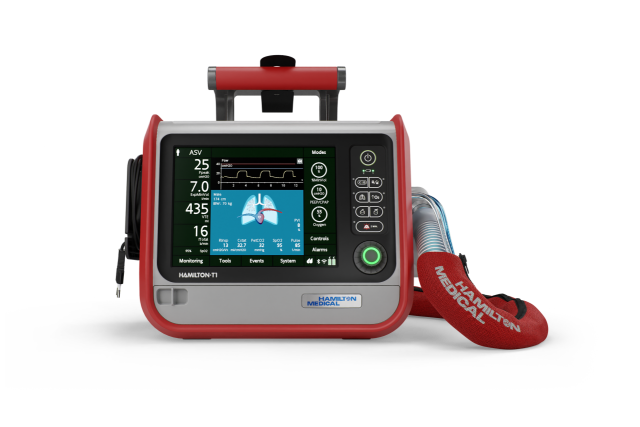
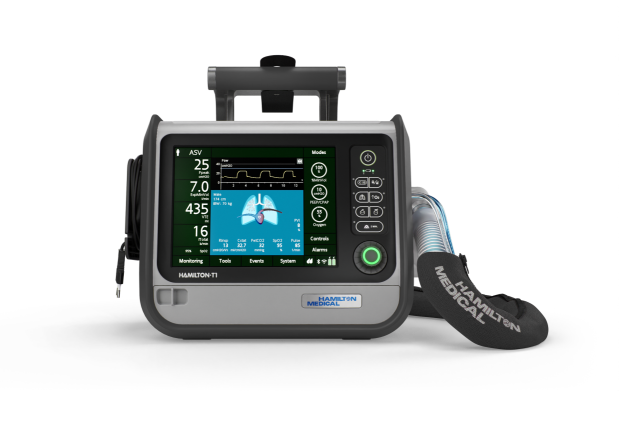
CPR ventilation is available as a standard feature on all HAMILTON-T1 devices.

Bag-Valve-Mask Ventilation and Survival From Out-of-Hospital Cardiac Arrest: A Multicenter Study.

Idris AH, Aramendi Ecenarro E, Leroux B, et al. Bag-Valve-Mask Ventilation and Survival From Out-of-Hospital Cardiac Arrest: A Multicenter Study. Circulation. 2023;148(23):1847-1856. doi:10.1161/CIRCULATIONAHA.123.065561

BACKGROUND Few studies have measured ventilation during early cardiopulmonary resuscitation (CPR) before advanced airway placement. Resuscitation guidelines recommend pauses after every 30 chest compressions to deliver ventilations. The effectiveness of bag-valve-mask ventilation delivered during the pause in chest compressions is unknown. We sought to determine: (1) the incidence of lung inflation with bag-valve-mask ventilation during 30:2 CPR; and (2) the association of ventilation with outcomes after out-of-hospital cardiac arrest. METHODS We studied patients with out-of-hospital cardiac arrest from 6 sites of the Resuscitation Outcomes Consortium CCC study (Trial of Continuous Compressions versus Standard CPR in Patients with Out-of-Hospital Cardiac Arrest). We analyzed patients assigned to the 30:2 CPR arm with ≥2 minutes of thoracic bioimpedance signal recorded with a cardiac defibrillator/monitor. Detectable ventilation waveforms were defined as having a bioimpedance amplitude ≥0.5 Ω (corresponding to ≥250 mL VT) and a duration ≥1 s. We defined a chest compression pause as a 3- to 15-s break in chest compressions. We compared the incidence of ventilation and outcomes in 2 groups: patients with ventilation waveforms in <50% of pauses (group 1) versus those with waveforms in ≥50% of pauses (group 2). RESULTS Among 1976 patients, the mean age was 65 years; 66% were male. From the start of chest compressions until advanced airway placement, mean±SD duration of 30:2 CPR was 9.8±4.9 minutes. During this period, we identified 26 861 pauses in chest compressions; 60% of patients had ventilation waveforms in <50% of pauses (group 1, n=1177), and 40% had waveforms in ≥50% of pauses (group 2, n=799). Group 1 had a median of 12 pauses and 2 ventilations per patient versus group 2, which had 12 pauses and 12 ventilations per patient. Group 2 had higher rates of prehospital return of spontaneous circulation (40.7% versus 25.2%; P<0.0001), survival to hospital discharge (13.5% versus 4.1%; P<0.0001), and survival with favorable neurological outcome (10.6% versus 2.4%; P<0.0001). These associations persisted after adjustment for confounders. CONCLUSIONS In this study, lung inflation occurred infrequently with bag-valve-mask ventilation during 30:2 CPR. Lung inflation in ≥50% of pauses was associated with improved return of spontaneous circulation, survival, and survival with favorable neurological outcome.

2025 American Heart Association Guidelines for Cardiopulmonary Resuscitation and Emergency Cardiovascular Care

Del Rios M, Bartos JA, Panchal AR, Atkins DL, Cabanas JG, Cao D, Dainty KN, Dezfulian C, Donoghue AJ, Drennan IR, Elmer J, Hirsch KG, Idris AH, Joyner BL, Kamath-Rayne BD, Kleinman ME, Kurz MC, Lasa JJ, Lee HC, McBride ME, Raymond TT, Rittenberger, JC, Schexnayder SM, Szyld E, Topjian A, Wigginton JG, Previdi JK. Part 1: executive summary: 2025 American Heart Association Guidelines for Cardiopulmonary Resuscitation and Emergency Cardiovascular Care. Circulation. 2025;152(suppl):S284–S312. doi: 10.1161/CIR.0000000000001372

European Resuscitation Council Guidelines 2025 Executive Summary.

Greif R, Lauridsen KG, Djärv T, et al. European Resuscitation Council Guidelines 2025 Executive Summary. Resuscitation. 2025;215 Suppl 1:110770. doi:10.1016/j.resuscitation.2025.110770

The 2025 European Resuscitation Council (ERC) Guidelines present the most up-to-date evidence-based guidelines for the practice of resuscitation across Europe. The ERC Guidelines 2025 are based on evidence produced by the International Liaison Committee on Resuscitation (ILCOR) in the form of systematic reviews, scoping reviews, and evidence updates, published as the ILCOR Consensus on Science with Treatment Recommendations. The certainty of evidence of these ILCOR treatment recommendations was used to issue the ERC Guidelines 2025 Recommendations. In some cases, the ERC made good practice statements when evidence was absent for certain topics. If no ILCOR review was available, the ERC writing groups conducted their own reviews to provide recommendations. The ERC Guidelines 2025 cover the epidemiology of cardiac arrest, the role that systems play in saving lives, adult basic life support, adult advanced life support, resuscitation in special circumstances, post resuscitation care, newborn resuscitation and support of transition of infants at birth, paediatric basic and advanced life support, resuscitation ethics, education for resuscitation, and first aid. These guidelines are a framework of recommendations for the approach to out-of-hospital and in-hospital resuscitation; the implementation is achieved locally taking local legislation and health care regulations into consideration.