


Session expired

Due to inactivity your session has expired. Please login again.

 技术

ASV - Adaptive Support Ventilation®。

为您及您的病人提供支持

"" ""

不只是一种模式。 这是 ASV

ASV 是一种智能模式,适用于儿童和成人病人有创通气。实时连续调整通气参数,以精确地提供每个病人所需的支持水平——不多也不少。

ASV 旨在提高速度和安全性,将循证通气与实时适应性相结合。在分秒必争的高压力环境中,ASV 可保障临床精度,让您安心。

ASV 在院前护理中的益处

适用于不同类型的病人

为从自主呼吸到需要完全通气支持的成人和儿童病人提供支持。

改善病人安全性

ASV 包括防止过度通气、通气不足和呼吸暂停等问题的安全机制 (Arnal JM, Wysocki M, Novotni D, et al.Safety and efficacy of a fully closed-loop control ventilation (IntelliVent-ASV®) in sedated ICU patients with acute respiratory failure: a prospective randomized crossover study.Intensive Care Med.2012;38(5):781-787. doi:10.1007/s00134-012-2548-61​, Kirakli C, Naz I, Ediboglu O, Tatar D, Budak A, Tellioglu E. A randomized controlled trial comparing the ventilation duration between adaptive support ventilation and pressure assist/control ventilation in medical patients in the ICU.Chest.2015;147(6):1503-1509. doi:10.1378/chest.14-25992​, Brunner JX, Iotti GA.Adaptive Support Ventilation (ASV).Minerva Anestesiol.2002;68(5):365-368.3)。 

这也有助于预防呼吸急促、AutoPEEP 和过度死腔通气等并发症 (Sulemanji D, Marchese A, Garbarini P, Wysocki M, Kacmarek RM.Adaptive support ventilation: an appropriate mechanical ventilation strategy for acute respiratory distress syndrome?.Anesthesiology.2009;111(4):863-870. doi:10.1097/ALN.0b013e3181b55f8f4)。

减轻认知负荷

减少呼吸机设置的更改次数,使您能够专注于病人护理的其他重要方面 (Kirakli C, Naz I, Ediboglu O, Tatar D, Budak A, Tellioglu E. A randomized controlled trial comparing the ventilation duration between adaptive support ventilation and pressure assist/control ventilation in medical patients in the ICU.Chest.2015;147(6):1503-1509. doi:10.1378/chest.14-25992​, Moradian ST, Saeid Y, Ebadi A, Hemmat A, Ghiasi MS.Adaptive Support Ventilation Reduces the Incidence of Atelectasis in Patients Undergoing Coronary Artery Bypass Grafting: A Randomized Clinical Trial.Anesth Pain Med.2017;7(3):e44619.2017 年 4 月 22 日出版。doi:10.5812/aapm.446195)。

持续自适应病人状态

当病人的病情发生变化时,ASV 会自动调整支持水平。
 

当病人呼吸费力时,它会增加通气辅助,当病人自主呼吸能力好转时,则降低辅助支持。

""

操作简单。 ASV 工作流程分为 4 个步骤

  1. 简单设置:设置病人的性别、身高和所需的分钟通气量。
  2. 持续监测:ASV 追踪潮气量、呼吸频率、气道压力等数据。
  3. 自动调整:ASV 调节吸气压力和频率以维持目标通气。
  4. 适应性响应:ASV 会随着自主呼吸努力的增加而减少支持——或在需要时加强支持。
     
Kyle Drisse

客户评语

ASV 对创伤病人非常有利,因为这类病人同时需要处理多项急症。只需安装呼吸机,交由 ASV 从肺部的角度管理病人,省心又便捷。设置也相当容易。

Kyle Drisse

重症监护飞行急救员
美国明尼苏达州 Life Link III

可用性

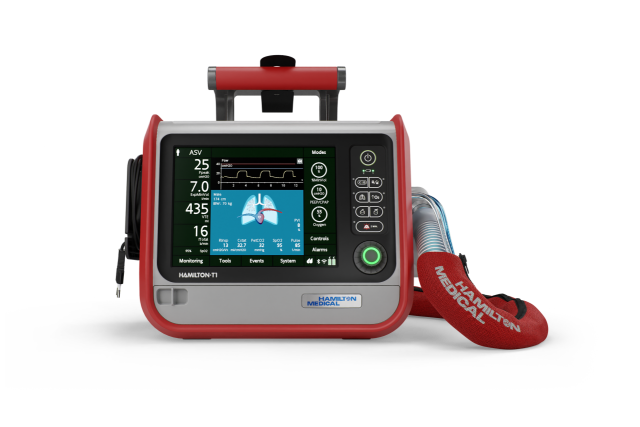
ASV 作为所有 HAMILTON-T1 呼吸机上的标准模式提供。

Safety and efficacy of a fully closed-loop control ventilation (IntelliVent-ASV®) in sedated ICU patients with acute respiratory failure: a prospective randomized crossover study.

Arnal JM, Wysocki M, Novotni D, et al. Safety and efficacy of a fully closed-loop control ventilation (IntelliVent-ASV®) in sedated ICU patients with acute respiratory failure: a prospective randomized crossover study. Intensive Care Med. 2012;38(5):781-787. doi:10.1007/s00134-012-2548-6

PURPOSE IntelliVent-ASV(®) is a development of adaptive support ventilation (ASV) that automatically adjusts ventilation and oxygenation parameters. This study assessed the safety and efficacy of IntelliVent-ASV(®) in sedated intensive care unit (ICU) patients with acute respiratory failure. METHODS This prospective randomized crossover comparative study was conducted in a 12-bed ICU in a general hospital. Two periods of 2 h of ventilation in randomly applied ASV or IntelliVent-ASV(®) were compared in 50 sedated, passively ventilated patients. Tidal volume (V(T)), respiratory rate (RR), inspiratory pressure (P(INSP)), SpO(2) and E(T)CO(2) were continuously monitored and recorded breath by breath. Mean values over the 2-h period were calculated. Respiratory mechanics, plateau pressure (P(PLAT)) and blood gas exchanges were measured at the end of each period. RESULTS There was no safety issue requiring premature interruption of IntelliVent-ASV(®). Minute ventilation (MV) and V(T) decreased from 7.6 (6.5-9.5) to 6.8 (6.0-8.0) L/min (p < 0.001) and from 8.3 (7.8-9.0) to 8.1 (7.7-8.6) mL/kg PBW (p = 0.003) during IntelliVent-ASV(®) as compared to ASV. P(PLAT) and FiO(2) decreased from 24 (20-29) to 20 (19-25) cmH(2)O (p = 0.005) and from 40 (30-50) to 30 (30-39) % (p < 0.001) during IntelliVent-ASV(®) as compared to ASV. RR, P(INSP), and PEEP decreased as well during IntelliVent-ASV(®) as compared to ASV. Respiratory mechanics, pH, PaO(2) and PaO(2)/FiO(2) ratio were not different but PaCO(2) was slightly higher during IntelliVent-ASV(®) as compared to ASV. CONCLUSIONS In passive patients with acute respiratory failure, IntelliVent-ASV(®) was safe and able to ventilate patients with less pressure, volume and FiO(2) while producing the same results in terms of oxygenation.

A randomized controlled trial comparing the ventilation duration between adaptive support ventilation and pressure assist/control ventilation in medical patients in the ICU.

Kirakli C, Naz I, Ediboglu O, Tatar D, Budak A, Tellioglu E. A randomized controlled trial comparing the ventilation duration between adaptive support ventilation and pressure assist/control ventilation in medical patients in the ICU. Chest. 2015;147(6):1503-1509. doi:10.1378/chest.14-2599

BACKGROUND Adaptive support ventilation (ASV) is a closed loop mode of mechanical ventilation (MV) that provides a target minute ventilation by automatically adapting inspiratory pressure and respiratory rate with the minimum work of breathing on the part of the patient. The aim of this study was to determine the effect of ASV on total MV duration when compared with pressure assist/control ventilation. METHODS Adult medical patients intubated and mechanically ventilated for > 24 h in a medical ICU were randomized to either ASV or pressure assist/control ventilation. Sedation and medical treatment were standardized for each group. Primary outcome was the total MV duration. Secondary outcomes were the weaning duration, number of manual settings of the ventilator, and weaning success rates. RESULTS Two hundred twenty-nine patients were included. Median MV duration until weaning, weaning duration, and total MV duration were significantly shorter in the ASV group (67 [43-94] h vs 92 [61-165] h, P = .003; 2 [2-2] h vs 2 [2-80] h, P = .001; and 4 [2-6] days vs 4 [3-9] days, P = .016, respectively). Patients in the ASV group required fewer total number of manual settings on the ventilator to reach the desired pH and Paco2 levels (2 [1-2] vs 3 [2-5], P < .001). The number of patients extubated successfully on the first attempt was significantly higher in the ASV group (P = .001). Weaning success and mortality at day 28 were comparable between the two groups. CONCLUSIONS In medical patients in the ICU, ASV may shorten the duration of weaning and total MV duration with a fewer number of manual ventilator settings. TRIAL REGISTRY ClinicalTrials.gov; No.: NCT01472302; URL: www.clinicaltrials.gov.

Adaptive Support Ventilation (ASV).

Brunner JX, Iotti GA. Adaptive Support Ventilation (ASV). Minerva Anestesiol. 2002;68(5):365-368.

Adaptive Support Ventilation is a novel ventilation mode, a closed-loop control mode that may switch automatically from a PCV-like behaviour to an SIMV-like or PSV-like behaviour, according to the patient status. The operating principles are based on pressure-controlled SIMV with pressure levels and SIMV rate automatically adjusted according to measured lung mechanics at each breath. ASV provided a safe and effective ventilation in patients with normal lungs, restrective or obstructive diseases. In cardiac surgery tracheal extrubation was faster in ASV patients then in controls. In the early weaning phase of acute ventilatory insufficiency the need of resetting ventilator parameters was decreased, suggesting potential benefit for patient care.

Adaptive support ventilation: an appropriate mechanical ventilation strategy for acute respiratory distress syndrome?

Sulemanji D, Marchese A, Garbarini P, Wysocki M, Kacmarek RM. Adaptive support ventilation: an appropriate mechanical ventilation strategy for acute respiratory distress syndrome?. Anesthesiology. 2009;111(4):863-870. doi:10.1097/ALN.0b013e3181b55f8f

BACKGROUND Adaptive support ventilation (ASV) allows the clinician to set a maximum plateau pressure (PP) and automatically adjusts tidal volume to keep PP below the set maximum. METHODS ASV was compared to a fixed tidal volume of 6 ml/kg. ASV determined the respiratory rate and tidal volume based on its algorithms. Maximum airway pressure limit was 28 cm H2O in ASV. Six sets of lung mechanics were simulated for two ideal body weights: 60 kg, Group I; 80 kg, Group II. Positive end expiratory pressure was 8, 12, and 16 cm H2O, and target minute volume 120%, 150%, and 200% of predicted minute volume. RESULTS ASV "sacrificed" tidal volume and minute ventilation to maintain PP in 9 (17%) of 54 scenarios in Group I and 20 (37%) of 54 scenarios in Group II. In Group I, the number of scenarios with PP of 28 cm H2O or more was 14 for ASV (26%) and 19 for 6 ml/kg (35%). In these scenarios, mean PP were ASV 28.8 +/- 0.86 cm H2O (min 28, max 30.3) and 6 ml/kg 33.01 +/- 3.48 cm H2O (min 28, max 37.8) (P = 0.000). In group II, the number of scenarios PP of 28 cm H2O or more was 10 for ASV (19%) and 21 for 6 ml/kg (39%). In these cases, mean PP values were ASV 28.78 +/- 0.54 cm H2O (min 28, max 29.6) and 6 ml/kg 32.66 +/- 3.37 cm H2O (min 28.2, max 38.2) (P = 0.000). CONCLUSION In a lung model with varying mechanics, ASV is better able to prevent the potential damaging effects of excessive PP (greater than 28 cm H2O) than a fixed tidal volume of 6 ml/kg by automatically adjusting airway pressure, resulting in a decreased tidal volume.

Adaptive Support Ventilation Reduces the Incidence of Atelectasis in Patients Undergoing Coronary Artery Bypass Grafting: A Randomized Clinical Trial.

Moradian ST, Saeid Y, Ebadi A, Hemmat A, Ghiasi MS. Adaptive Support Ventilation Reduces the Incidence of Atelectasis in Patients Undergoing Coronary Artery Bypass Grafting: A Randomized Clinical Trial. Anesth Pain Med. 2017;7(3):e44619. Published 2017 Apr 22. doi:10.5812/aapm.44619

BACKGROUND Pulmonary complications are common following cardiac surgery and can lead to increased morbidity, mortality, and healthcare costs. Atelectasis is the most common respiratory complication following cardiac surgery. One of the most important methods for reducing pulmonary complications is supportive care with protective ventilation strategies. In this study, we aimed to assess the effect of adaptive support ventilation (ASV) on atelectasis in patients undergoing cardiac surgery. METHODS In this single-blind randomized clinical trial, 115 patients, undergoing coronary artery bypass grafting, were randomly allocated into 2 groups: 57 patients in the intervention and 58 patients in the control group. Patients in the intervention group were weaned with ASV, while patients in the control group were managed using synchronized intermittent mandatory ventilation (SIMV) and pressure support. The incidence of atelectasis, duration of mechanical ventilation, manual ventilator setting, arterial blood gas measurements, and length of hospital stay were compared between the groups. RESULTS The incidence of atelectasis, number of changes in the manual ventilator setting, number of alarms, and length of hospital stay reduced in the intervention group. However, duration of mechanical ventilation and number of ABG measurements were not significantly different between the groups. CONCLUSIONS The ASV mode could reduce the incidence of atelectasis and length of hospital stay. However, it did not reduce the duration of mechanical ventilation. It seems that ASV is not a superior mode for faster extubation.