


Session expired

Due to inactivity your session has expired. Please login again.

 技术

INTELLiVENT®-ASV®。

您在转运途中的助手

"" ""

转运途中的智能通气。 这是 INTELLiVENT-ASV

转运过程中的通气管理要求很高。病人病情可能迅速恶化,每次调整都需要宝贵的时间。INTELLiVENT-ASV 基于实时氧饱和度和 etCO2 测量值自动控制通气和氧合,为您的插管成人和儿童病人提供支持。

INTELLiVENT-ASV 对院前护理的益处

自动适应

INTELLiVENT-ASV 不断调整呼吸频率、潮气量、吸气压力、PEEP 和氧浓度,并在控制通气和辅助通气之间切换,所有这些都基于每次呼吸时评估的生理输入数据 (Bialais E, Wittebole X, Vignaux L, et al.Closed-loop ventilation mode (IntelliVent®-ASV) in intensive care unit: a randomized trial.Minerva Anestesiol.2016;82(6):657-668.1​, Fot EV, Izotova NN, Yudina AS, Smetkin AA, Kuzkov VV, Kirov MY.Automated Weaning from Mechanical Ventilation after Off-Pump Coronary Artery Bypass Grafting.Front Med (Lausanne).2017;4:31.2017 年 3 月 21 日出版。doi:10.3389/fmed.2017.000312​, Arnal JM, Saoli M, Garnero A. Airway and transpulmonary driving pressures and mechanical powers selected by INTELLiVENT-ASV in passive, mechanically ventilated ICU patients.Heart Lung.2020;49(4):427-434. doi:10.1016/j.hrtlng.2019.11.0013​)。

节省时间并减少工作量

INTELLiVENT‑ASV 需要比传统通气更少的手动调整,有助于降低您的工作量,使您就可以专注于您的病人 (Bialais E, Wittebole X, Vignaux L, et al.Closed-loop ventilation mode (IntelliVent®-ASV) in intensive care unit: a randomized trial.Minerva Anestesiol.2016;82(6):657-668.1​, Fot EV, Izotova NN, Yudina AS, Smetkin AA, Kuzkov VV, Kirov MY.Automated Weaning from Mechanical Ventilation after Off-Pump Coronary Artery Bypass Grafting.Front Med (Lausanne).2017;4:31.2017 年 3 月 21 日出版。doi:10.3389/fmed.2017.000312​, Beijers AJ, Roos AN, Bindels AJ.Fully automated closed-loop ventilation is safe and effective in post-cardiac surgery patients.Intensive Care Med. 2014;40(5):752-753. doi:10.1007/s00134-014-3234-74​).

改善病人安全性

即使在不稳定的情况下也能维持肺保护性通气,降低高氧血症或通气不足/过度通气的风险 (Bialais E, Wittebole X, Vignaux L, et al.Closed-loop ventilation mode (IntelliVent®-ASV) in intensive care unit: a randomized trial.Minerva Anestesiol.2016;82(6):657-668.1​, Fot EV, Izotova NN, Yudina AS, Smetkin AA, Kuzkov VV, Kirov MY.Automated Weaning from Mechanical Ventilation after Off-Pump Coronary Artery Bypass Grafting.Front Med (Lausanne).2017;4:31.2017 年 3 月 21 日出版。doi:10.3389/fmed.2017.000312​, Arnal JM, Saoli M, Garnero A. Airway and transpulmonary driving pressures and mechanical powers selected by INTELLiVENT-ASV in passive, mechanically ventilated ICU patients.Heart Lung.2020;49(4):427-434. doi:10.1016/j.hrtlng.2019.11.0013​)。

简化复杂性

在高压力转运过程中以及对于具有不同经验水平的医护人员来说尤其有价值。

""

极为简便。 INTELLiVENT-ASV 工作流程分为 4 个步骤

  1. 设置基础数据:输入病人的性别、身高和病情(如 ARDS、脑创伤或慢性高碳酸血症)。
  2. 定义目标值:为病人选择氧合(氧饱和度)和通气 (etCO2) 范围。
  3. 开始通气:INTELLiVENT-ASV 自动调整潮气量、呼吸频率、FiO2 和 PEEP 以达到这些目标值,并根据氧饱和度、etCO2 和肺力学指标按每次呼吸不断调整设置。
  4. 根据需要进行微调:如果您想自己管理设置(MinVol、氧浓度或 PEEP),可以将三个控件中的任何一个设置为手动。
João Alves 博士

客户评语

从临床护理的角度来看,INTELLIVENT-ASV 使我们能够在处理决策中更关键的职责时,对病人实施背景工作。

João Alves 博士

监护医师,内科和急诊科,自 2018 年
里斯本大学附属医院中心,葡萄牙里斯本

可用性

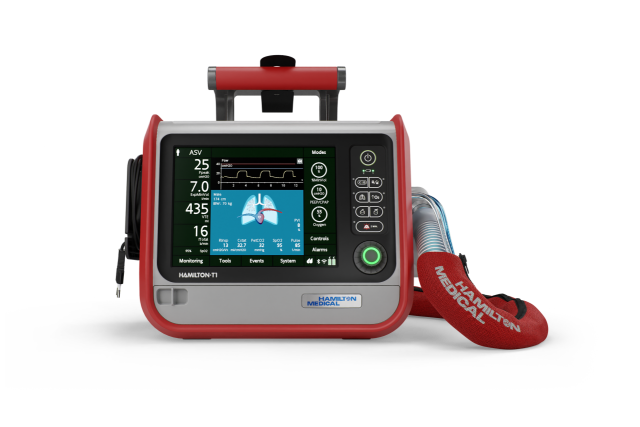
INTELLiVENT-ASV 可作为所有 HAMILTON-T1 呼吸机的选配模式提供。

Closed-loop ventilation mode (IntelliVent®-ASV) in intensive care unit: a randomized trial.

Bialais E, Wittebole X, Vignaux L, et al. Closed-loop ventilation mode (IntelliVent®-ASV) in intensive care unit: a randomized trial. Minerva Anestesiol. 2016;82(6):657-668.

BACKGROUND Closed-loop modes automatically adjust ventilation settings, delivering individualized ventilation over short periods of time. The objective of this randomized controlled trial was to compare safety, efficacy and workload for the health care team between IntelliVent®-ASV and conventional modes over a 48-hour period. METHODS ICU patients admitted with an expected duration of mechanical ventilation of more than 48 hours were randomized to IntelliVent®-ASV or conventional ventilation modes. All ventilation parameters were recorded breath-by-breath. The number of manual adjustments assesses workload for the healthcare team. Safety and efficacy were assessed by calculating the time spent within previously defined ranges of non-optimal and optimal ventilation, respectively. RESULTS Eighty patients were analyzed. The median values of ventilation parameters over 48 hours were similar in both groups except for PEEP (7[4] cmH2O versus 6[3] cmH2O with IntelliVent®-ASV and conventional ventilation, respectively, P=0.028) and PETCO2 (36±7 mmHg with IntelliVent®-ASV versus 40±8 mmHg with conventional ventilation, P=0.041). Safety was similar between IntelliVent®-ASV and conventional ventilation for all parameters except for PMAX, which was more often non-optimal with IntelliVent®-ASV (P=0.001). Efficacy was comparable between the 2 ventilation strategies, except for SpO2 and VT, which were more often optimal with IntelliVent®-ASV (P=0.005, P=0.016, respectively). IntelliVent®-ASV required less manual adjustments than conventional ventilation (P<0.001) for a higher total number of adjustments (P<0.001). The coefficient of variation over 48 hours was larger with IntelliVent®-ASV in regard of maximum pressure, inspiratory pressure (PINSP), and PEEP as compared to conventional ventilation. CONCLUSIONS IntelliVent®-ASV required less manual intervention and delivered more variable PEEP and PINSP, while delivering ventilation safe and effective ventilation in terms of VT, RR, SpO2 and PETCO2.

Automated Weaning from Mechanical Ventilation after Off-Pump Coronary Artery Bypass Grafting.

Fot EV, Izotova NN, Yudina AS, Smetkin AA, Kuzkov VV, Kirov MY. Automated Weaning from Mechanical Ventilation after Off-Pump Coronary Artery Bypass Grafting. Front Med (Lausanne). 2017;4:31. Published 2017 Mar 21. doi:10.3389/fmed.2017.00031

BACKGROUND The discontinuation of mechanical ventilation after coronary surgery may prolong and significantly increase the load on intensive care unit personnel. We hypothesized that automated mode using INTELLiVENT-ASV can decrease duration of postoperative mechanical ventilation, reduce workload on medical staff, and provide safe ventilation after off-pump coronary artery bypass grafting (OPCAB). The primary endpoint of our study was to assess the duration of postoperative mechanical ventilation during different modes of weaning from respiratory support (RS) after OPCAB. The secondary endpoint was to assess safety of the automated weaning mode and the number of manual interventions to the ventilator settings during the weaning process in comparison with the protocolized weaning mode. MATERIALS AND METHODS Forty adult patients undergoing elective OPCAB were enrolled into a prospective single-center study. Patients were randomized into two groups: automated weaning (n = 20) using INTELLiVENT-ASV mode with quick-wean option; and protocolized weaning (n = 20), using conventional synchronized intermittent mandatory ventilation (SIMV) + pressure support (PS) mode. We assessed the duration of postoperative ventilation, incidence and duration of unacceptable RS, and the load on medical staff. We also performed the retrospective analysis of 102 patients (standard weaning) who were weaned from ventilator with SIMV + PS mode based on physician's experience without prearranged algorithm. RESULTS AND DISCUSSION Realization of the automated weaning protocol required change in respiratory settings in 2 patients vs. 7 (5-9) adjustments per patient in the protocolized weaning group. Both incidence and duration of unacceptable RS were reduced significantly by means of the automated weaning approach. The FiO2 during spontaneous breathing trials was significantly lower in the automated weaning group: 30 (30-35) vs. 40 (40-45) % in the protocolized weaning group (p < 0.01). The average time until tracheal extubation did not differ in the automated weaning and the protocolized weaning groups: 193 (115-309) and 197 (158-253) min, respectively, but increased to 290 (210-411) min in the standard weaning group. CONCLUSION The automated weaning system after off-pump coronary surgery might provide postoperative ventilation in a more protective way, reduces the workload on medical staff, and does not prolong the duration of weaning from ventilator. The use of automated or protocolized weaning can reduce the duration of postoperative mechanical ventilation in comparison with non-protocolized weaning based on the physician's decision.

Airway and transpulmonary driving pressures and mechanical powers selected by INTELLiVENT-ASV in passive, mechanically ventilated ICU patients.

Arnal JM, Saoli M, Garnero A. Airway and transpulmonary driving pressures and mechanical powers selected by INTELLiVENT-ASV in passive, mechanically ventilated ICU patients. Heart Lung. 2020;49(4):427-434. doi:10.1016/j.hrtlng.2019.11.001

BACKGROUND Driving pressure (ΔP) and mechanical power (MP) are predictors of the risk of ventilation- induced lung injuries (VILI) in mechanically ventilated patients. INTELLiVENT-ASV® is a closed-loop ventilation mode that automatically adjusts respiratory rate and tidal volume, according to the patient's respiratory mechanics. OBJECTIVES This prospective observational study investigated ΔP and MP (and also transpulmonary ΔP (ΔPL) and MP (MPL) for a subgroup of patients) delivered by INTELLiVENT-ASV. METHODS Adult patients admitted to the ICU were included if they were sedated and met the criteria for a single lung condition (normal lungs, COPD, or ARDS). INTELLiVENT-ASV was used with default target settings. If PEEP was above 16 cmH2O, the recruitment strategy used transpulmonary pressure as a reference, and ΔPL and MPL were computed. Measurements were made once for each patient. RESULTS Of the 255 patients included, 98 patients were classified as normal-lungs, 28 as COPD, and 129 as ARDS patients. The median ΔP was 8 (7 - 10), 10 (8 - 12), and 9 (8 - 11) cmH2O for normal-lungs, COPD, and ARDS patients, respectively. The median MP was 9.1 (4.9 - 13.5), 11.8 (8.6 - 16.5), and 8.8 (5.6 - 13.8) J/min for normal-lungs, COPD, and ARDS patients, respectively. For the 19 patients managed with transpulmonary pressure ΔPL was 6 (4 - 7) cmH2O and MPL was 3.6 (3.1 - 4.4) J/min. CONCLUSIONS In this short term observation study, INTELLiVENT-ASV selected ΔP and MP considered in safe ranges for lung protection. In a subgroup of ARDS patients, the combination of a recruitment strategy and INTELLiVENT-ASV resulted in an apparently safe ΔPL and MPL.

Fully automated closed-loop ventilation is safe and effective in post-cardiac surgery patients.

Beijers AJ, Roos AN, Bindels AJ. Fully automated closed-loop ventilation is safe and effective in post-cardiac surgery patients. Intensive Care Med. 2014;40(5):752-753. doi:10.1007/s00134-014-3234-7